
India’s $750M Quantum Computing Push, a $1.8B SPAC Showdown, and the Enterprise AI Race Accelerates
Defiance ETFs: Weekly Market Update | February 11, 2026

Hi everyone,
Three things happened this week that tell the same story. India broke ground on a 50-acre quantum campus with IBM hardware arriving by year-end. Infleqtion’s $1.8 billion SPAC merger goes to shareholder vote on Wednesday. And D-Wave reported that customer usage of its quantum systems jumped 314% in the past twelve months. Each of these is significant on its own. Together, they paint a picture of a sector that has quietly moved past the “when will this matter?” phase.
India Is Building a Quantum Ecosystem, Not Just a Computer
On February 7, the state of Andhra Pradesh laid the foundation stone for the Amaravati Quantum Valley: a 50-acre campus that will house India’s first 133-qubit quantum computer, built on IBM’s Heron processor and housed in an IBM Quantum System Two. The hardware is targeted for installation by December 2026, and IBM is providing it at no capital cost under a four-year agreement.
What caught my attention isn’t the computer itself. It’s what’s being built around it. Nine MoUs were signed with IBM, TCS, and L&T. Academic institutions secured 365 hours of free annual computing time. SRM University-AP is standing up a Quantum Reference Facility so startups and researchers can actually access the tools. And India’s broader National Quantum Mission has committed roughly $750 million across 43 institutions in 17 states.
This matters because quantum has a chicken-and-egg problem: you need infrastructure to develop applications, but you need applications to justify infrastructure. India is solving this by building the ecosystem from both ends at once. For anyone tracking where the next wave of quantum talent and startups will come from, this is worth watching.
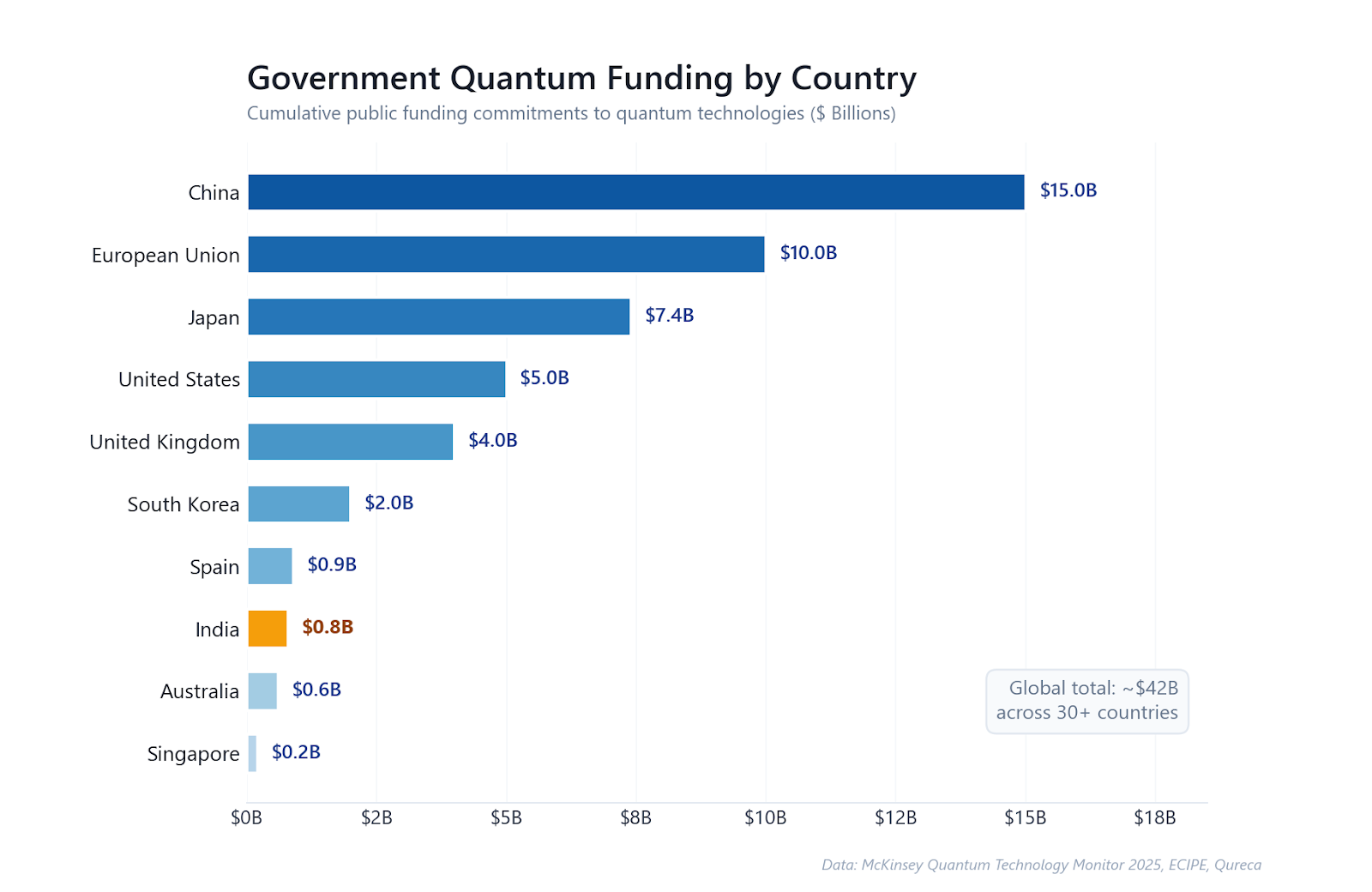
Governments worldwide have committed roughly $42 billion in cumulative public funding to quantum technologies. India’s $800 million commitment positions it alongside South Korea, Spain, and Australia as emerging quantum hubs. Source: McKinsey Quantum Technology Monitor 2025, ECIPE, Qureca
The Infleqtion Vote Signals Something Bigger
On Wednesday, shareholders of Churchill Capital Corp X will vote on a merger that would take Infleqtion public at a $1.8 billion valuation with over $540 million in gross proceeds. The PIPE backing includes Morgan Stanley’s Counterpoint Global, Maverick Capital, and Glynn Capital. If approved, the neutral-atom quantum company will trade on the NYSE under the ticker INFQ within days.
Look at who is writing these checks. This isn’t venture capital betting on a 10-year horizon. Infleqtion has $29 million in trailing twelve-month revenue growing at roughly 80% annually, with customers that include NVIDIA and the Department of Defense. And it’s not alone: Quantinuum filed confidential IPO paperwork at a potential $20 billion valuation, and Horizon Quantum Computing is pursuing a SPAC combination valued near $1 billion.
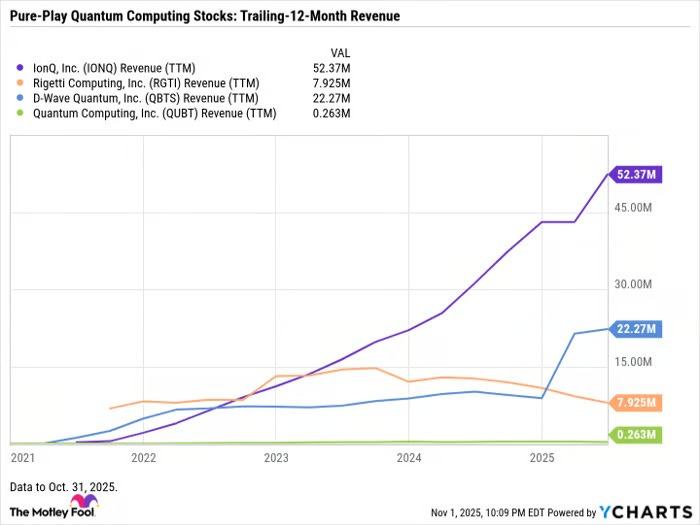
Pure-play quantum companies are generating real revenue, with IonQ leading at $52M TTM. Source: YCharts via The Motley Fool (data to Oct. 31, 2025)
The sector is crossing a line from venture-backed research into public market capital formation. That changes the investor landscape meaningfully.
The Hybrid Playbook Is Already Running
Meanwhile, the enterprise side isn’t waiting for fault-tolerant quantum to arrive with a bow on it. At CES 2026, Dell Technologies outlined a strategy for hybrid quantum-classical computing that treats quantum processors as specialized accelerators plugged into existing infrastructure. NVIDIA’s CUDA-Q platform is powering quantum-GPU hybrid workflows at more than a dozen supercomputing centers globally. And that D-Wave usage number, 314% growth in one year, tells you that real workloads are moving onto quantum systems right now, not in some future roadmap.
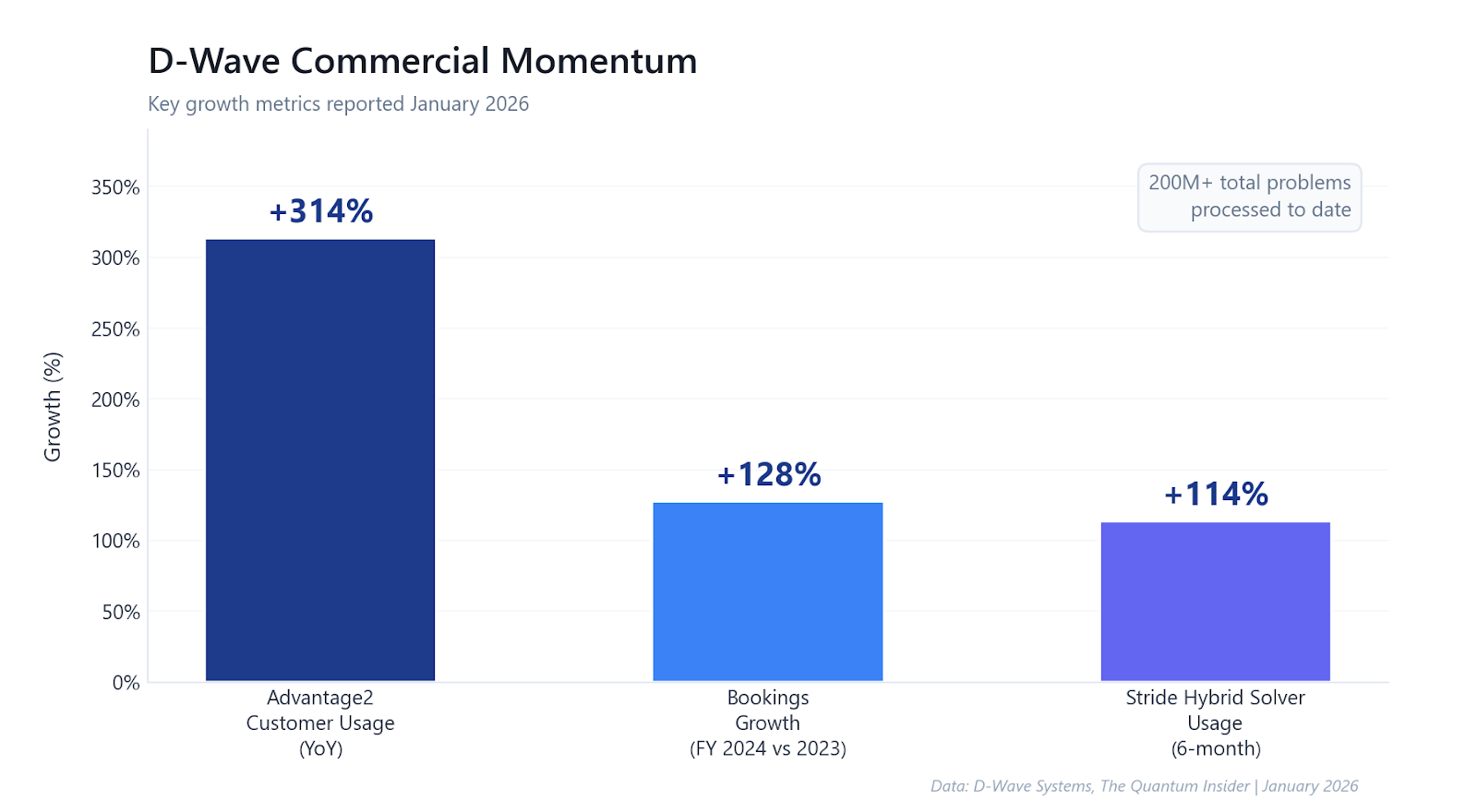
D-Wave reported triple-digit growth across customer usage, bookings, and hybrid solver adoption, with over 200 million problems processed to date. Source: D-Wave Systems, The Quantum Insider (January 2026)
IonQ CEO Niccolò de Masi has been making this point consistently: quantum systems are already compressing what would take months on classical machines into days. His broader argument is that countries and corporations that move early on infrastructure and standards will hold a structural advantage for the next decade.
What This Means for Portfolios
I want to step back from the individual headlines and talk about what the pattern looks like.
A year ago, the quantum investment conversation was dominated by two questions: when will these companies generate revenue, and when will governments commit serious capital? Both of those questions now have concrete answers. Revenue is real and growing. Governments have committed a cumulative $55.7 billion in public quantum support globally. The risk profile has shifted.
That doesn’t mean the risks have disappeared. Pure-play valuations are stretched, error correction at scale remains unsolved, and profitability timelines are uncertain for most names in the space. But the conversation has moved from “will this technology work?” to “who captures value as it scales?”
For those evaluating exposure to quantum computing and AI, the expanding geographic footprint and institutional capital flows add a layer of durability that wasn’t there twelve months ago. And as the infrastructure buildout widens beyond a handful of mega-cap names, there’s a reasonable case that companies outside the Magnificent Seven are positioned to benefit from the spending wave in ways the market hasn’t fully priced.
I’ll be watching the Infleqtion vote closely on Wednesday. More next week.
Best regards,
Sylvia Jablonski, CIO
Follow us on X (Twitter) | LinkedIn