
The Quantum Computing Inflection Point: How Scalability Breakthroughs Are Triggering an Infrastructure Arms Race
Defiance ETFs: Weekly Market Update | December 18, 2025

Hi everyone,
This week delivered one of those rare moments where the technology roadmap shifts dramatically. QuantWare unveiled its VIO-40K architecture, a 3D wiring solution that enables 10,000-qubit quantum processors, a 100-fold increase over current industry standards. For investors watching companies in the quantum computing space, the convergence of government validation, institutional capital, and breakthrough manufacturing scale signals this sector is moving beyond speculation. Meanwhile, Big Tech doubled down on AI spending commitments, and governments from Canada to India signaled that quantum and AI infrastructure are now matters of national strategic priority. Here’s what I’m seeing and why it matters.
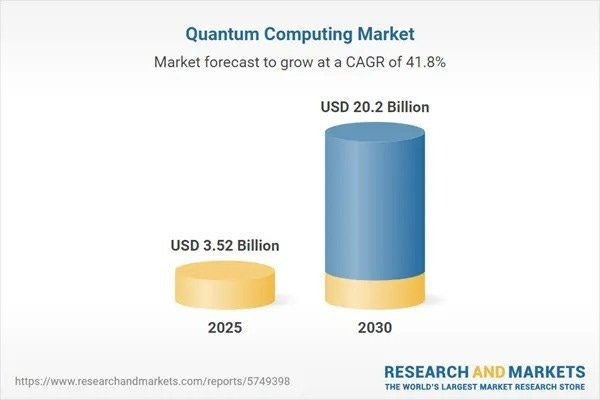
The quantum computing market is projected to grow at a 41.8% CAGR through 2030, with McKinsey forecasting up to $97 billion in total quantum technology revenue by 2035.
The Scalability Breakthrough Changes Everything
For nearly a decade, the quantum computing industry has been stuck at roughly 100 qubits per processor. Google moved from 53 to 105 qubits over six years, and IBM’s roadmap shows 120 qubits as its leading device through 2028. The bottleneck wasn’t demand or funding. It was hardware architecture. Traditional 2D wiring consumes nearly 90% of chip area for signal routing rather than qubits.
QuantWare’s solution uses vertical wiring that delivers signals directly to qubits in a 3D stack, supporting 40,000 input-output lines through chiplet modules with ultra-high-fidelity chip-to-chip connections. The result: exponentially more compute per dollar and per watt compared to networked multi-processor approaches. First devices ship in 2028, but the company is building Kilofab, one of the world’s largest quantum fabrication facilities, in Delft, Netherlands, opening next year to scale production capacity by 20x.
This is smart positioning. When fault-tolerant quantum systems eventually arrive, the companies with manufacturing infrastructure will capture the value. Nvidia has already integrated its NVQLink platform into the VIO-40K ecosystem, connecting hyperscale quantum compute with low-latency classical AI supercomputing via CUDA-Q.
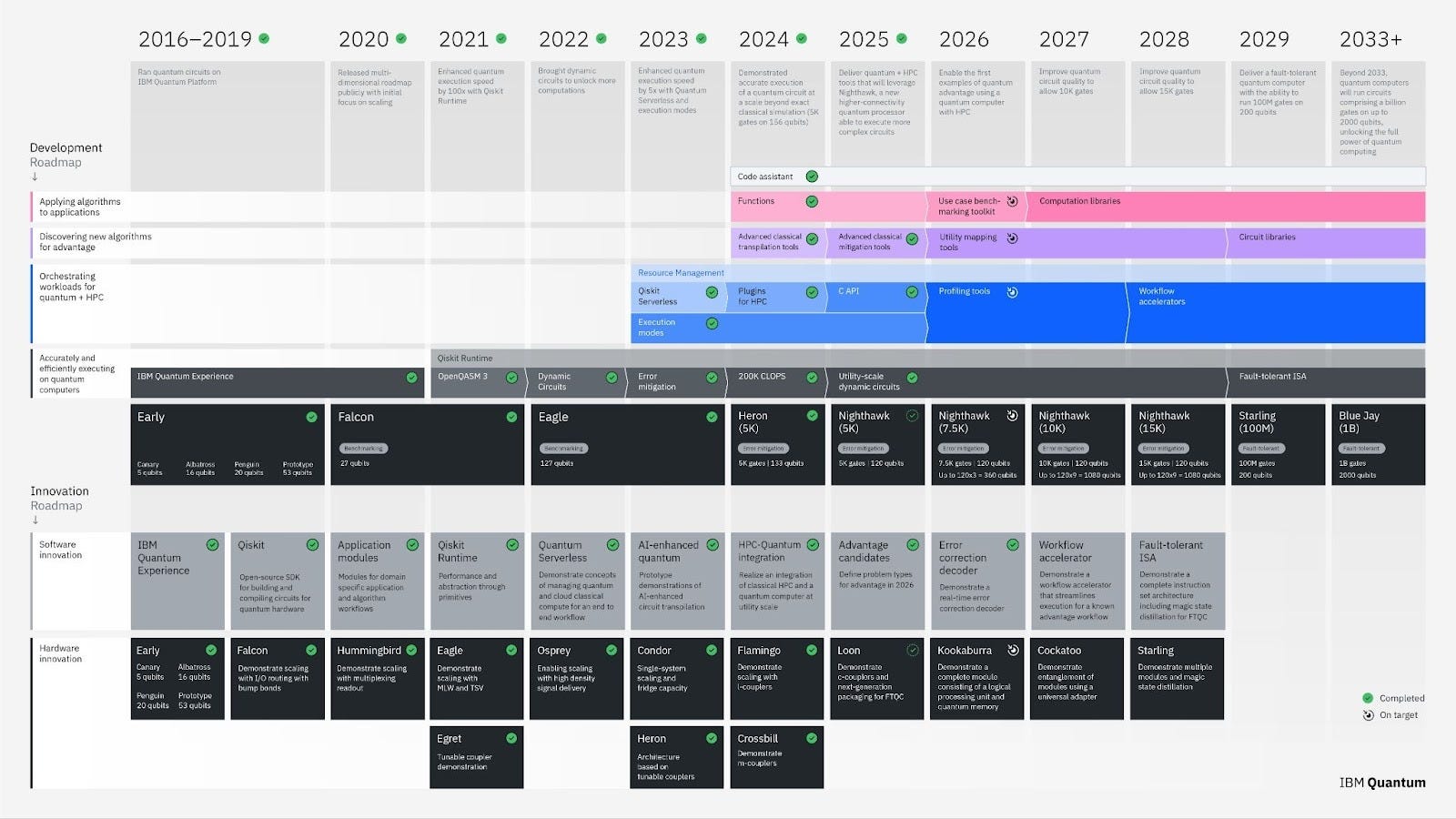
IBM’s quantum development roadmap illustrates the industry’s path from hundreds to thousands of qubits, with fault-tolerant systems targeted for 2029 and beyond. Source: IBM
Governments Are Placing Strategic Bets
Canada launched the Canadian Quantum Champions Program this week, committing $92 million in Phase 1 funding to four domestic firms: Anyon Systems, Nord Quantique, Photonic, and Xanadu. Each company receives up to $23 million to advance fault-tolerant quantum systems. The program sits within a broader $334.3 million five-year commitment tied to Canada’s Defence Industrial Strategy, a clear signal that quantum capabilities are viewed as critical national infrastructure.
What caught my attention: Canada explicitly requires participating companies to remain headquartered domestically. The program also includes an independent benchmarking platform through the National Research Council to verify technical progress. Canada’s quantum sector is projected to contribute $17.7 billion to GDP and more than 157,000 jobs by 2045.
Meanwhile, Karnataka, India, is pursuing a $20 billion quantum economy. The state’s Chief Minister requested federal support for a Quantum Materials Innovation Network in Bengaluru, proposing approximately Rs 150 crore for materials infrastructure. Karnataka’s Quantum Mission includes India’s first Quantum Hardware Park, manufacturing zones, and a dedicated quantum venture capital fund.
Governments announced $1.8 billion in quantum technology funding in 2024 alone. The U.S. National Quantum Initiative, EU Quantum Flagship, and China’s National Quantum Laboratory collectively represent tens of billions in committed capital. This isn’t speculative research funding anymore. It’s infrastructure investment.
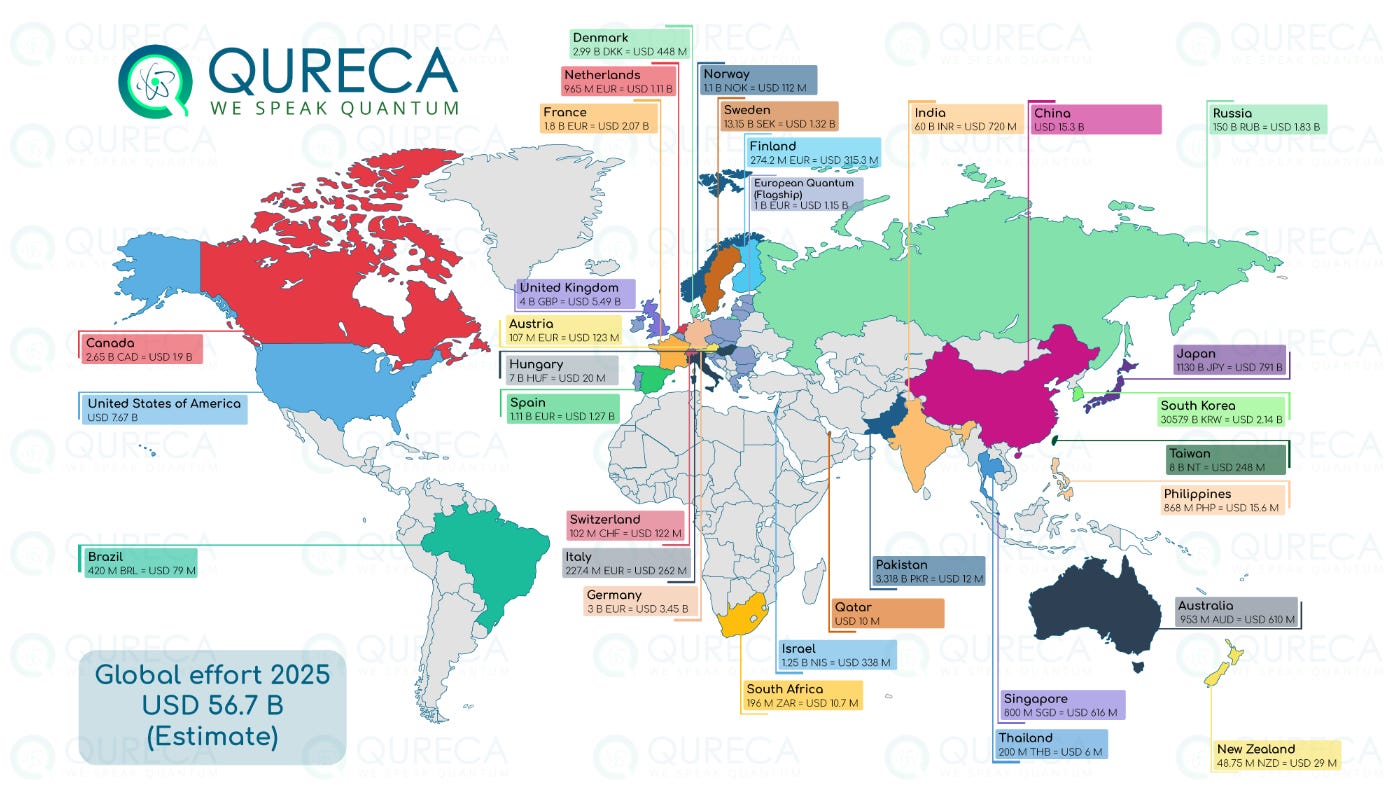
Global government quantum investment reached an estimated $56.7 billion in 2025, with the U.S., China, and Japan leading national commitments. Source: Qureca (Oct 15, 2025)
Pure-Play Quantum Companies Are Executing
The sector-wide momentum is showing up in company results. IonQ (NYSE: IONQ) reported Q3 2025 revenue of $39.9 million, representing 222% year-over-year growth and 37% above the top end of guidance. The company raised full-year revenue expectations to $106-110 million and now holds $3.5 billion in pro-forma cash following a $2 billion equity offering. IonQ achieved a world-record 99.99% two-qubit gate performance and delivered its #AQ 64 algorithmic qubit milestone three months ahead of schedule.
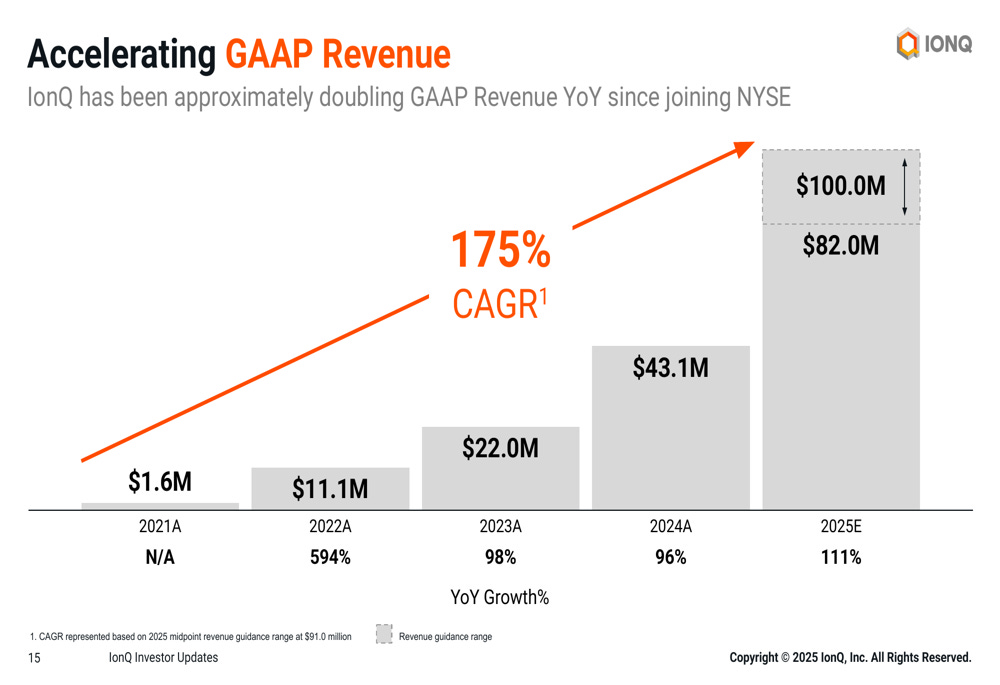
IonQ has approximately doubled annual revenue year-over-year since going public, with full-year 2025 guidance since raised to $106-110 million. Source: IonQ Investor Updates (Q2 2025)
Rigetti Computing (NASDAQ: RGTI) is executing on its aggressive roadmap while expanding partnerships globally. The company secured $5.7 million in purchase orders for two 9-qubit Novera systems, was awarded a $5.8 million AFRL contract to advance superconducting quantum networking in collaboration with QphoX, and announced an Italian subsidiary to pursue European opportunities. Rigetti’s roadmap targets 100+ qubits with 99.5% gate fidelity by year-end, 150+ qubits by late 2026, and 1,000+ qubits by 2027. The company holds approximately $600 million in cash to fund this scaling plan.
Cloud access is accelerating adoption. Both IonQ and Rigetti make their quantum computers available through Amazon Web Services Braket, Microsoft Azure Quantum, and Google Cloud Marketplace. This hybrid quantum-classical approach is precisely where Nvidia’s NVQLink integration matters, creating a pathway from experimental workloads to production-scale quantum computing.
The AI-Quantum Convergence
The quantum story cannot be separated from AI infrastructure. Big Tech continues committing staggering capital to AI compute. Alphabet, Meta, Microsoft, and Amazon collectively expect capital expenditures exceeding $380 billion this fiscal year, with Microsoft’s CFO stating demand growth continues to outpace supply. Amazon’s capital expenditures hit $125 billion for 2025, with guidance pointing even higher for 2026.
The intersection matters because quantum computing and AI are increasingly complementary. AI is being used to optimize quantum error correction and system design, while quantum computing promises to accelerate certain AI workloads. McKinsey’s research indicates hybrid quantum-classical systems are emerging as the practical path to quantum advantage, with cloud platforms from AWS, Azure, and Google Cloud making these systems accessible to enterprises experimenting with quantum-enhanced applications.
Security leaders at Kyndryl and Palo Alto Networks are warning that quantum computing and autonomous AI will reshape cybersecurity by 2026. The quantum timeline for cryptographic threats has compressed from a ten-year horizon to three years, according to industry forecasts. Organizations deploying AI agents now face an 82:1 machine-to-human identity ratio, creating new attack surfaces. Yet only 3% of organizations have implemented quantum-resistant measures.
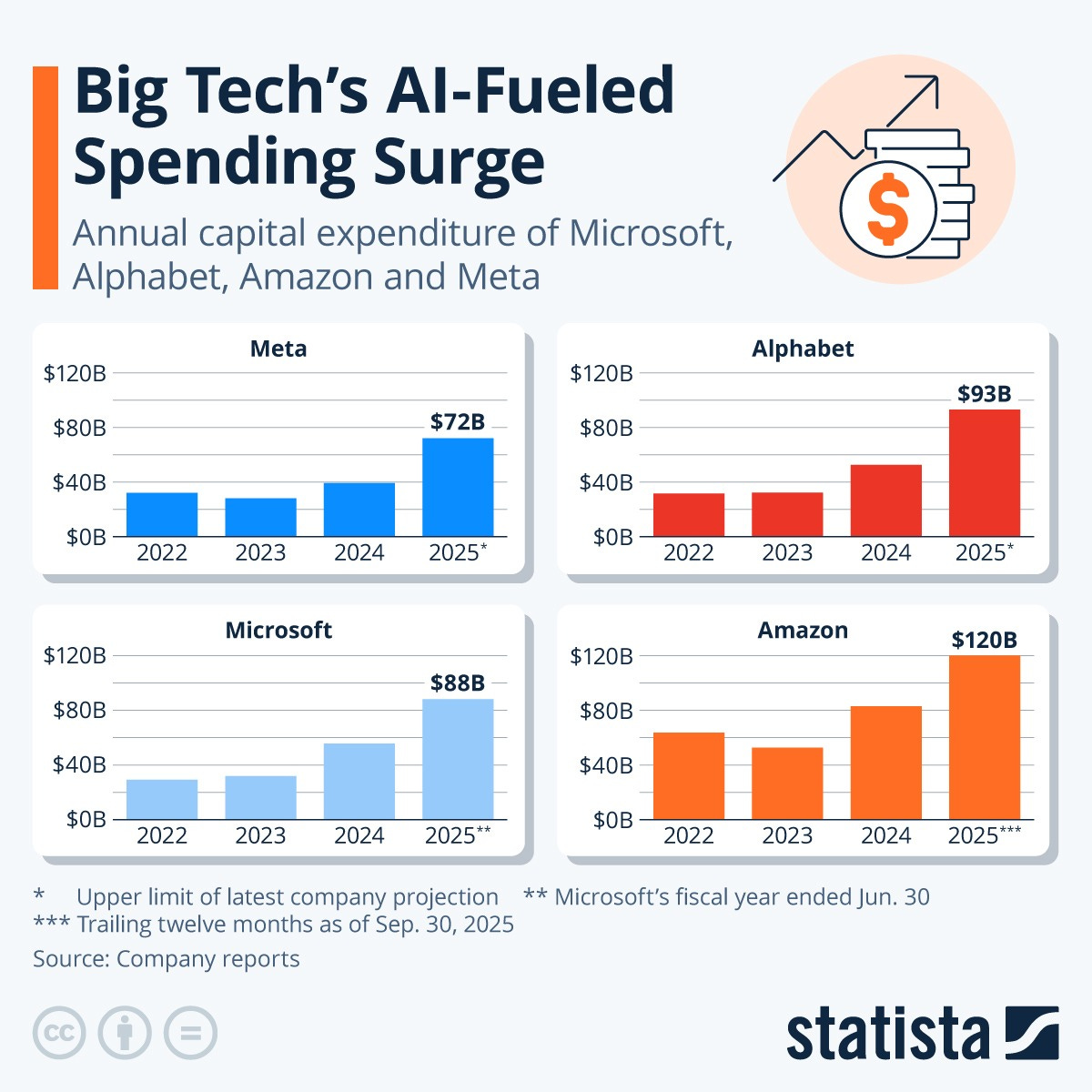
Big Tech’s collective AI infrastructure spending exceeds $370 billion in 2025, with each major hyperscaler significantly increasing capital expenditure year-over-year.
What This Means for Investors
The quantum computing market is projected to grow from $3.52 billion in 2025 to $20.2 billion by 2030, representing a 41.8% compound annual growth rate. McKinsey’s latest Quantum Technology Monitor projects quantum technologies could generate up to $97 billion in revenue worldwide by 2035, with quantum computing capturing $72 billion of that total. Quantum computing companies alone generated $650-750 million in revenue in 2024 and are expected to surpass $1 billion in 2025.
The investment landscape spans pure-play hardware innovators like IonQ and Rigetti, enabling technology providers like Intel and AMD developing quantum-relevant semiconductors, and the Big Tech platforms (Alphabet, Microsoft, Amazon) building hybrid quantum-classical systems into cloud infrastructure. For those looking at diversification beyond the largest tech names, the broader market includes hundreds of companies contributing to quantum and AI infrastructure across the value chain.
The takeaway from this week is clear: capital, talent, and national strategy are converging around quantum and AI technologies. The infrastructure build-out has years to run, and the companies positioning manufacturing capabilities now are laying the groundwork for what comes next.
Best regards,
Sylvia Jablonski
CEO & CIO
Follow us on X (Twitter) | LinkedIn