
Three Pricing Surfaces, One Trading Week: The Quantum Public Market Gets Its Calibration Event
Defiance ETFs: Weekly Market Update | June 3, 2026

Hi everyone,
Three independent quantum pricing surfaces all moved inside one trading week. On Monday this week, Quantinuum upsized its IPO to $1.46 billion at a $53 to $55 range on 26.5 million shares, lifting fully diluted valuation to roughly $14.3 billion at the midpoint. Pricing is scheduled for the evening of June 3, with the tape opening under the ticker QNT on June 4.
On the same Monday morning, D-Wave published a gate-model roadmap to 100 logical qubits by 2032, the first fault-tolerance date the company has committed to in writing. And on May 21, the Department of Commerce announced $2.013 billion in CHIPS Act letters of intent across nine quantum companies, with the federal government taking a minority equity stake in each as a condition of the award.
For allocators reading the publicly listed quantum cohort the price discovery now flows through, the calibration event is no longer a question of whether the IPO clears. It is a question of how the multiple settles when three independent surfaces all move in the same trading week.
Quantinuum’s Upsize Is Where the Bid-Book Lives
The book moved fast. The May 26 launch range was $45 to $50 on roughly 21 million shares, implying $12.7 billion at the top. Five trading days later, the company upsized the offering to 26.5 million shares and lifted the range to $53 to $55, a 13 percent bump on the high end and a 26 percent expansion in shares. That is the visible signal that the joint book run by JPMorgan and Morgan Stanley is materially oversubscribed.
At the $54 midpoint, Quantinuum prices at roughly 462 times its 2025 revenue of $30.9 million, against a 2025 bookings line of $79.3 million and a net loss of $192.6 million. The reference comp is IonQ, which trades at a market capitalization of roughly $27 billion. What the market is about to publish on June 4 is the first clearing multiple the public quantum cohort has had on a contracting-business income statement rather than a press release.
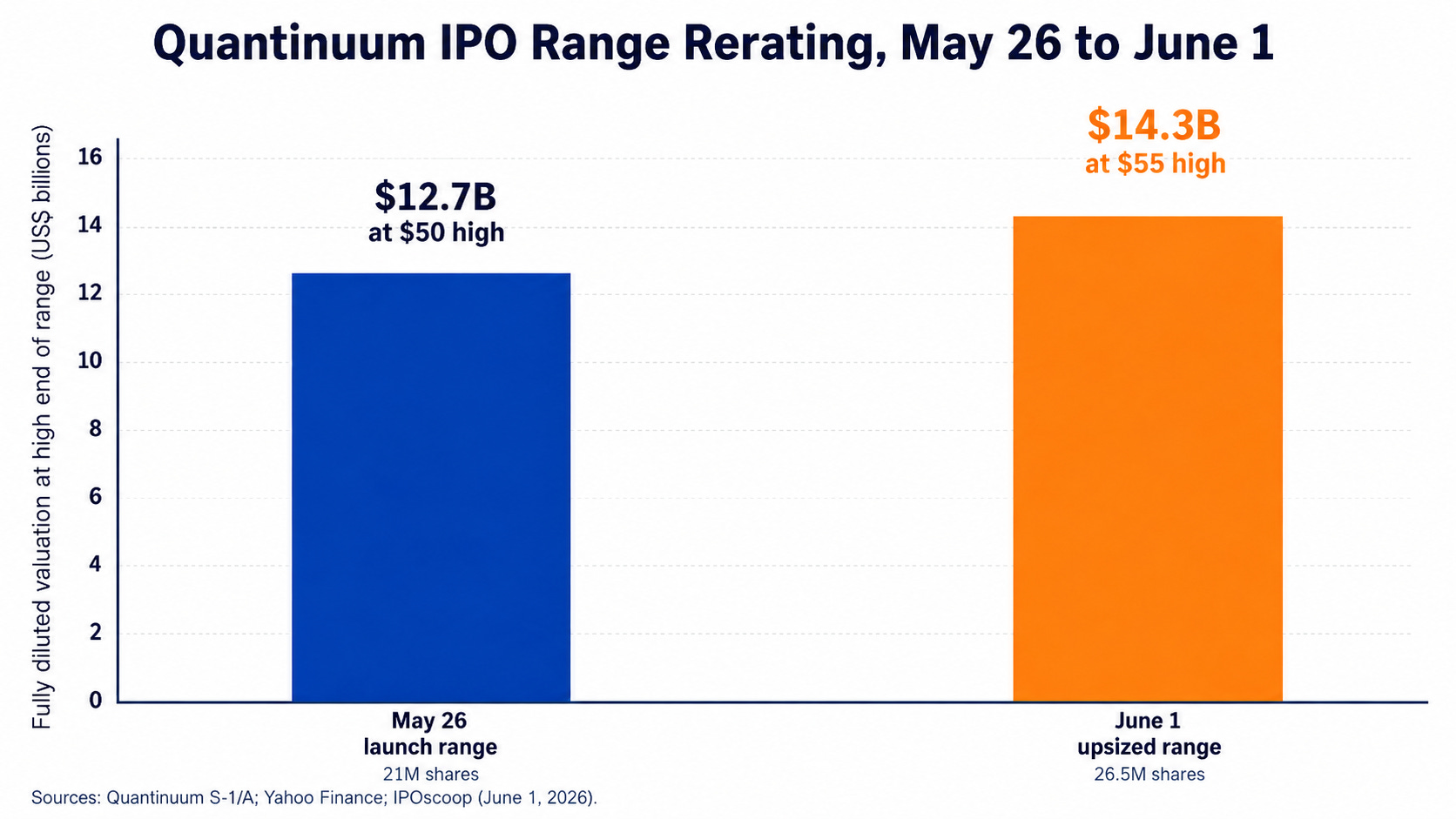
The IPO range expanded in size and price across five trading days as the book filled. Sources: Quantinuum S-1/A, Yahoo Finance, IPOScoop (June 1, 2026).
The Federal Government Sits on the Cap Table Now
The Commerce Department announcement on May 21 changed the structure of who owns the quantum cohort. The $2.013 billion in CHIPS Act letters of intent is distributed across nine recipients. IBM receives roughly $1 billion to anchor a new domestic quantum chip foundry called Anderson. GlobalFoundries receives $375 million for a second foundry track. Three publicly listed quantum companies, D-Wave, Rigetti, and Infleqtion, each receive approximately $100 million. Quantinuum sits in the same $100 million tier on a separate Commerce letter tied to its trapped-ion systems. Australian quantum company Diraq receives $38 million.
What matters for the cohort multiple is the structure. The Department takes a minority, non-controlling equity stake in every recipient. The public quantum cohort is now partly sovereign-backed. Investors pricing the QNT book on June 3 are pricing a security where the Treasury is a minority shareholder of three of its closest comparables.
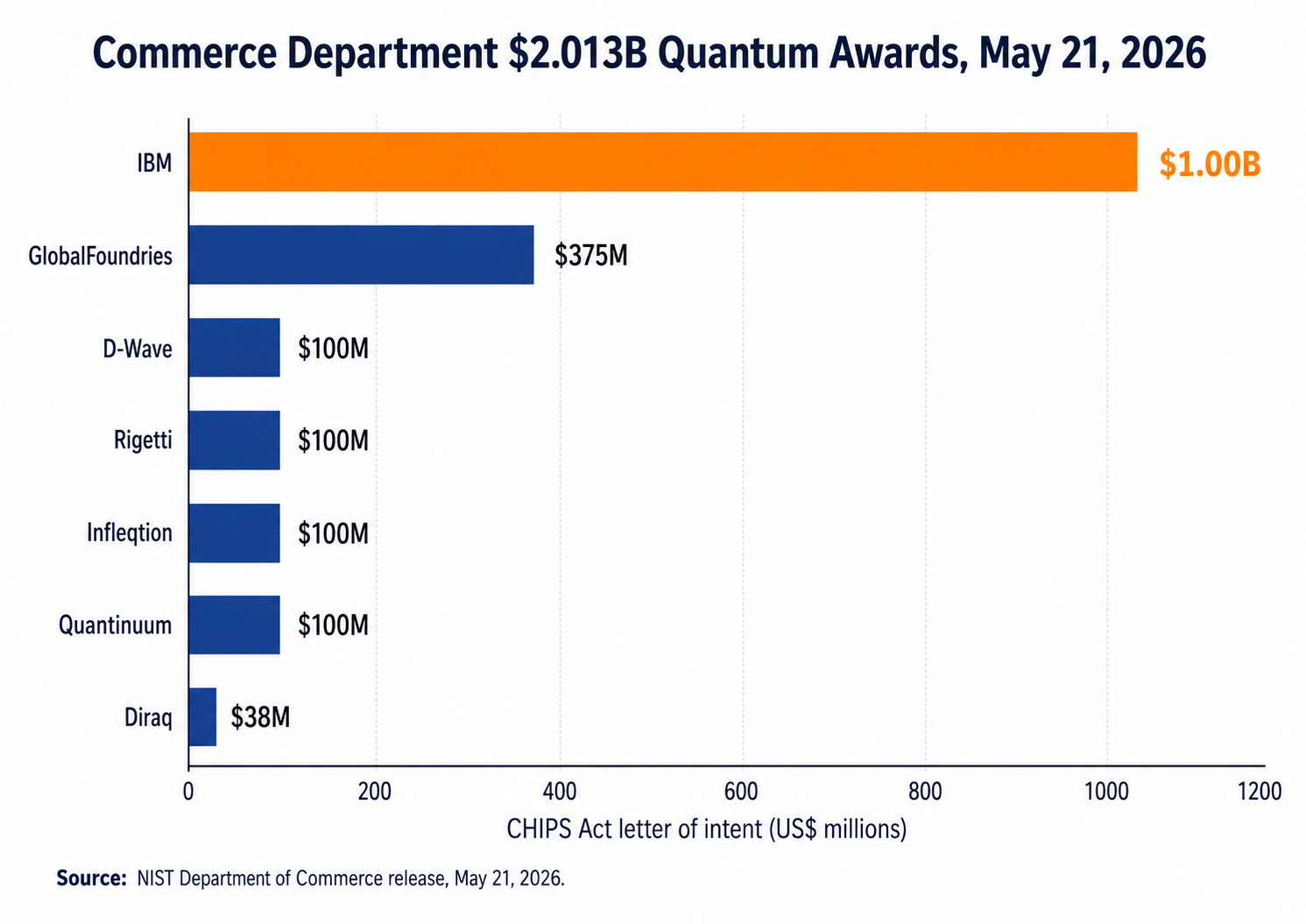
The $2.013 billion in CHIPS Act letters of intent broken out by recipient. Source: NIST release, May 21, 2026.
D-Wave Put a 2032 Date on Fault Tolerance
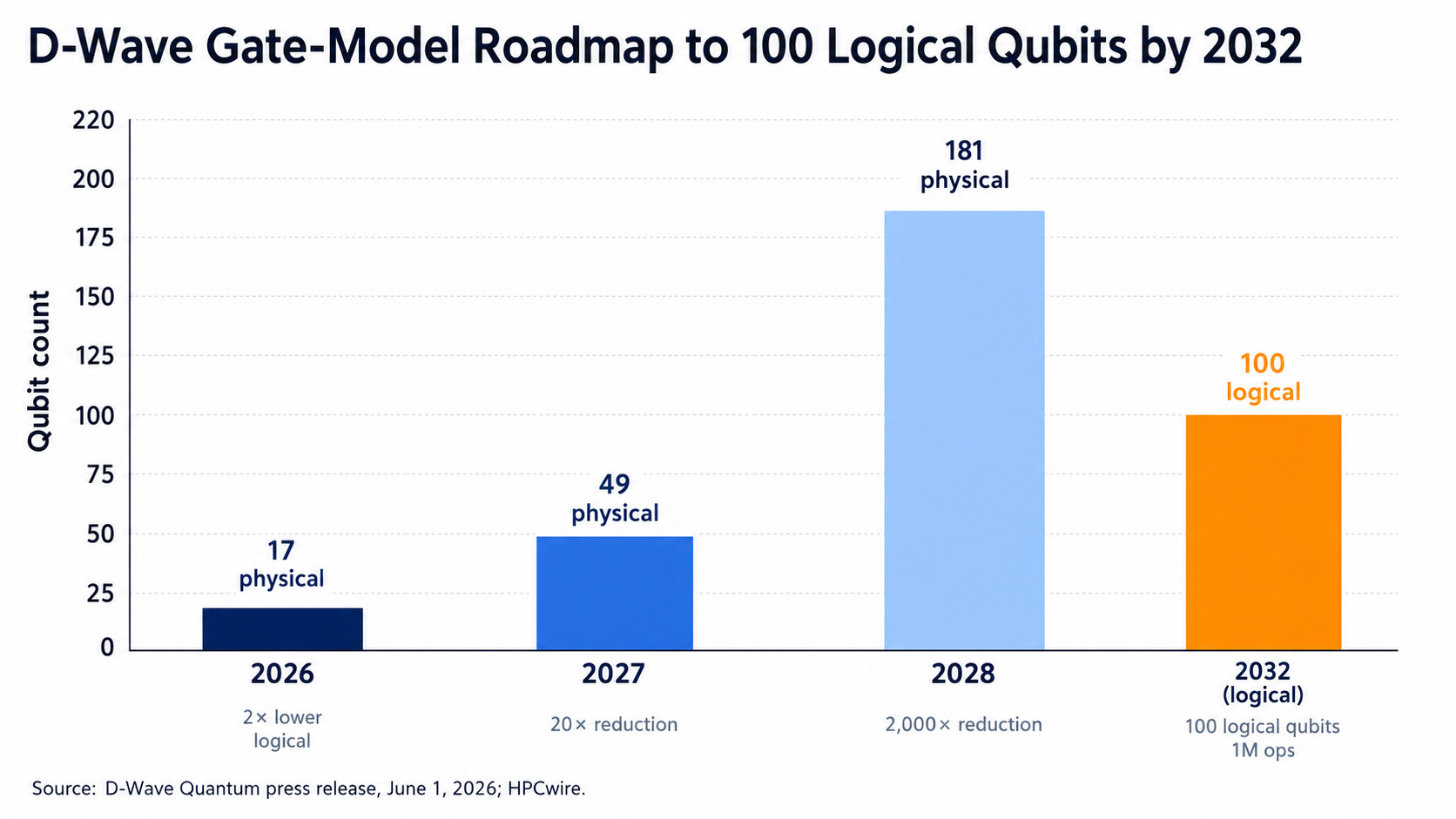
The third surface moved on the same Monday morning Quantinuum upsized. D-Wave published a gate-model roadmap committing to 100 logical qubits by 2032, capable of more than one million error-corrected operations. The roadmap is fully gated. A 17-physical-qubit dual-rail superconducting system ships in 2026 at a logical error rate roughly two times lower than physical. A 49-physical-qubit system follows in 2027 at an expected 20-fold reduction. A 181-physical-qubit system follows in 2028 at an expected 2,000-fold reduction. The architecture targets a Lambda of 10, against the current industry demonstrated Lambda of roughly 2.
The strategic read is that D-Wave is adding a gate-model fault-tolerant lane on top of its annealing platform. That expands the company’s addressable market from optimization workloads to the full quantum advantage envelope where IonQ and Quantinuum compete. Three publicly traded quantum companies now have written fault-tolerance dates in their disclosures.
The roadmap is fully gated by physical-qubit milestones in 2026, 2027, and 2028, with the logical-qubit target landing in 2032. Source: D-Wave Quantum press release, June 1, 2026; HPCwire.
Three Calibrators, One Window
The maturation signal is the convergence. The IPO clears, the federal equity arrives, the leading platform vendor publishes a fault-tolerance date. Each surface independently re-prices the cohort. Quantinuum’s clearing multiple on June 4 sets the comp grid for IonQ, D-Wave, Rigetti, and Infleqtion for the next two quarters. The $2 billion Commerce program changes the long-term gross-margin profile of every recipient through cheaper capital and foundry access, but introduces a minority taxpayer dilution that has to be priced into the equity story. D-Wave’s roadmap puts a fact pattern in the disclosures: gate-model fault tolerance is now a competitive surface, not a thesis.
The risks worth surfacing. A 462x trailing revenue multiple demands a clean trading debut and tight execution against the bookings line. Equity-stake CHIPS deals carry political risk if administration priorities shift. Gate-model roadmaps that span six years carry execution risk that does not price into the multiple until milestones miss.
What to Watch Next
June 3 evening prices the book. June 4 opens the tape. The first 30 trading days establish whether the $54 midpoint holds against the $12.7 billion to $14.3 billion bid-build the underwriters just published.
The 180-day Honeywell lockup, currently roughly 49 percent of post-IPO voting power, becomes the next structural pressure point. The IonQ, D-Wave, Rigetti, and Infleqtion Q2 earnings cycle in August will be the first cycle to read against three new structural facts: the QNT clearing multiple, the Commerce equity, and the 2032 fault-tolerance dates on the page.
The price discovery this week is the calibration event the cohort has been moving toward for the better part of two years.
Best regards,
Sylvia Jablonski
CIO, Defiance ETFs
Follow us on X (Twitter) | LinkedIn